17 November 2006

Follow the money

Both the Newcastle Herald and the Sydney Morning Herald report today that developer Hardie Holdings may escape penalties for alleged illegal land clearing in the Hunter due to a decision by the NSW Labor government to include the land in the Lower Hunter Regional Strategy.

Hardie Holdings is recorded as a donor to the NSW Labor Party in the most recent (2004/5) electoral commission donations disclosures (see the Democracy4Sale website).

The company had also engaged former NSW Labor powerbroker Graham Richardson as a lobbyist.

According to the media reports, the Department of Natural Resources had ordered Hardie Holdings to repair ecologically sensitive land it had damaged at its Sweetwater development, near Branxton.

Hardie Holdings appealed against this order to the NSW Land and Environment Court.

However, the Department has now confirmed that it is no longer pursuing the matter because – under the plan released last month by Labor’s Planning Minister, Frank Sartor - the land would no longer be protected by relevant environmental protection laws.

A spokesperson for Mr Sartor denied that there was any deal.

A spokesperson for The Wilderness Society, Reece Turner, described the government’s decision as “completely bizarre”, but this will not be the first (and is unlikely to be the last) time that the NSW Labor government has assisted developers by retrospectively changing the rules: they did this in the 90s to overturn a Land and Environment Court decision against a sandmining developer at Tomago, and to block legal objections to the Port Kembla copper smelter.

The Greens will continue to oppose developer donations to political parties.

16 November 2006

One ear for mining, one for oil

Howard: one ear for mining, one for oil, but none for scientists and environmentalists.

To whom does John Howard look for advice about climate change and energy policy?

The Sydney Morning Herald's Environment Reporter, Wendy Frew, reports today that the Prime Minister has been talking to BHP, Rio Tinto Aluminium and Chevron Oil about emissions trading.

[Note: BHP and Rio Tinto are both listed as donors to the Federal Liberal Party in the most recent (2004/5) donation disclosures.]

Frew says “It appears scientists, energy experts and environmentalists will not be consulted although they have been long-term supporters of such a global scheme.”

The article goes on to quote Howard as warning that he will not support any scheme that “would damage Australia’s fossil fuel sector or energy-intensive industries such as aluminium, steel and cement”, and that he would not enter into any global agreement without “tough emission reduction targets for developing nations such as China and India”.

China and India have already signed and ratified the Kyoto agreement, though the treaty recognises their status as developing nations. See my earlier blog entry. The ethical basis of Kyoto was that human induced climate change has been caused primarily by developed nations, and that the onus for reducing emissions should fall primarily on them. An exception was made for Australia (which has signed but not ratified Kyoto), which was entitled under the agreement to an 8% increase in greenhouse gas emission on the benchmark 1990 levels.

The Howard Government has refused to ratify Kyoto, despite even this modest obligation. In doing so, Australia is internationally alienated, and our capacity to be part of global negotiations on Climate Change policy is severely compromised.

Ironically, for a government so ostensibly concerned about the economic impact of Kyoto on Australia, the Howard approach to climate change and energy has also cost Australia jobs and trade opportunities, and is likely to be a significant impediment to Australia entering any global emissions trading system.

The Australian also mentions that the French are now talking about taxing imports from countries that have not committed themselves to the second phase of the Kyoto Protocol, as a stand against “environmental dumping”. What a turnaround from the days when Australia – quite legitimately – protested against French nuclear testing in the Pacific. Howard has now made Australia an environmental pariah, even in the eyes of the French.

The cloak of Emperor Howard’s climate change rhetoric – tailored by big mining and oil interests - is making him look decidedly naked.

15 November 2006

Some water facts

Hunter Water's Integrated Water Resource Plan highlights that one of the best ways to save water (and therefore make it available for another use, like transferring it to the Central Coast) is to invest in water efficiency in the home.

About 8,000 properties in the Lower Hunter have had water efficient refit (and energy efficient refit) freeing up 240 million litres and saving people $1.4 million (as well as saving 43,220 tonnes of greenhouse gases over the product life) - now that's integration! See the report on the Refit program.

Now here's an announcement...

* All 200,000 properties in Hunter Water's area of operations will be given the refit deal, freeing up 6 billion litres of water, costing $24 million and saving $35 million for each household. Greenhouse savings of 1 million tonnes.

* All 200,000 properties in Hunter Water's area of operations will be given an interest free loan for a rainwater tank and be able to pay it off through their water bills - Hunter Water could arrange for a bulk-buying price from local manufacturers. Cost is lost interest on money, assuming 10% take-up per year (20,000 rain water tanks) cost would be about $6 million. Could free up 15 billion litres.

* Major recycling projects for parks, gardens and industry to free up 10 billion litres (current industrial use alone is 10 billion litres per year). Cost approx $50 million.

Total cost $80 million
Total water freed up 31 billion litres per year
Amount required for Central Coast 13 billion litres per year

Using water wisely?

According to the California Energy Commission (cited in Paul Gipe's WIND ENERGY COMES OF AGE, John Wiley & Sons, 1995), the water used to generate electricity from non-renewables is considerable.

Nuclear 2.3 litres for each kilowatt hour
Coal 1.9 litres for each kilowatt hour
Solar 0.110 litres for each kilowatt hour
Wind 0.004 litres for each kilowatt hour

According to the latest national water account (2001) the Electricity and gas supply industries used almost as much water (1,687,778 million litres) as the water industry (1,793,953 million litres)

Is that using water wisely?

Come clean on coal

The Newcastle Herald today ("Come clean on coal", 15 November 2006, p.20) took up my open letter to the Vice Chancellor of the University of Newcastle regarding concerns about possible conflicts of interest and threats to academic independence and integrity arising from coal industry funded research at the university.

The article quoted the university’s Deputy Vice-Chancellor (Research), Professor Barney Glover, as saying that the amount of funding in privately backed research arrangements was generally confidential.

The confidentiality of such research funding arrangements reinforces my concerns about the lack of public disclosure and transparency in these matters. Such confidentiality is totally inconsistent with the principles and tradition of free and open academic inquiry, and has the potential to compromise the crucial trust between the public and the academics involved in such research.

The public (as both citizens and taxpayers) is surely entitled to know exactly who is funding any research project involving academics who are working for a public institution such as the University of Newcastle. This is especially so where such funding might be perceived as influencing the views of academics who participate in public debate involving issues affecting the funding provider.

I do appreciate Professor Glover’s point that the university’s research on coal is “on ways of making its combustion cleaner”, and I have no problem at all with the university being involved in such research.

My point here, however, is that if such research is being funded by the coal industry, this could be a factor influencing the views of relevant academics about the role of “clean coal” technologies in future energy policy, especially at a time when the debate is centred around whether such technologies offer an end-point “solution” to climate change (as the coal industry would have us believe), or whether they should be part of a transition in the eventual phasing out of coal as an energy source (as The Greens advocate).

The Newcastle Herald article (by Professor Scott Holmes of the university’s research unit) that prompted my letter supported the position taken by the coal industry. But – despite Professor Holmes’ position as a key university research administrator - the article did not disclose the fact that the university receives significant research funding from the industry that he was defending.

I should add that I am very pleased that what Professor Glover calls the university’s “burgeoning renewable energy research” is involved in “cutting edge” projects. The Greens have always argued that renewable energy is the real solution to a truly sustainable energy future, and I – and other Greens – strongly support any research that takes us toward that objective.

However, the funding sources behind even this research should still be disclosed.

As we have seen in other contexts (e.g, the Cash-for-Comment affairs, developer donations to political parties, etc), significant problems can arise when vested interests intervene without disclosure in public processes that require the highest standards of integrity, accountability and transparency. Academic research is such a process, and its integrity should not be eroded (or even be perceived to be compromised) by any secrecy or lack of full disclosure.

When funding sources are kept confidential, it can create the impression of an attempt to hide the funding source from public view. This, in turn, can raise questions about the motivations for the research, and create the further impression of an attempt to exploit the public trust and credibility associated with academic research for purposes that have more to do with the objectives of the (undisclosed) vested interests, than with the public interest.

If the university has allowed itself to become party to keeping research funding sources confidential (as Professor Glover's response implies), it should rethink such arrangements in the interests of both its public accountability, and the integrity of the academic research process itself.

I intend to raise this matter with both our Federal and State Greens parliamentarians.

In relation to Professor Glover’s point that the university “posted its overall funding contributions and this information was available to the public”, I could not locate such information on the university’s website. Perhaps the response I receive from the university will indicate where I can find this information.

If so, I’ll let blog readers know where they can find it.

See a related article in yesterday's Sydney Morning Herald.

14 November 2006

CSIRO lectures

Last night I went along to the CSIRO Energy Transformed Flagship lecture series at the CSIRO Energy Centre on the Steel River Estate.

The first speaker talked about how the National Solar Energy Centre was continuing its collaborative research into efficient, low emission energy generation particularly renewables and hydrogen. An interesting point made was that if all the electricity needs of Newcastle were to be satisfied from existing solar panel technologies they could be met from an area of 4 kilometres by 4 kilometres of solar panels, certainly a lot less than the rooftops of buildings in Newcastle.

The second speaker outlined the Distributed Energy Management and Control project which is looking for ways to improve the efficiency of electricity utilities and networks by facilitating the way they interact with their customer base. An example could be "smart agents" that receive and communicate information such as consumer preferences, price signals, weather conditions, etc between neighbouring sites and remote utilities to control when appliances are switched on and off.

Check out the CSIRO website and Newcastle Council's ClimateCam website.

Kyoto

For your information...

China ratified the Kyoto protocol on 30 August 2002 and India ratified the Kyoto protocol on 26 August 2002.

The Protocol entered into force on 16 February 2005 - the ninetieth day after at least 55 Parties to the Convention, incorporating Annex I Parties which accounted in total for at least 55 % of the total carbon dioxide emissions for 1990 from that group, deposited their instruments of ratification, acceptance, approval or accession.

The Orkopoulos Dam


Newcastle Greens
MEDIA RELEASE
14 November 2006

The Orkopoulos Dam

The State Government’s announcement of a new dam in the Hunter is a dangerous ploy to distract people from the disarray of Sydney Labor and the Milton Orkopoulos affair, says Greens candidate for Newcastle Cr Michael Osborne.

“The Sydney Labor Government is stuck in the past. The only reason they would announce such a silly idea is to draw attention away from the Orkopoulos affair.

“This dam would inundate thousands of hectares of dairy country, destroy the hydrology of an iconic Hunter river and be far less cost effective than many demand management and water conservation initiatives.

“Just over a year ago Hunter Water highlighted in its submission to the Independent Pricing and Regulatory Tribunal that ‘there are no plans to build Tillegra Dam in the short to medium term’ and in their Integrated Water Resource Plan Hunter Water said that ‘building a new dam at Tillegra would be far less cost effective than many demand management and water conservation initiatives’ (page 66) yet the State Government ignores this advice and opts for the grand dam idea.

“If the Government was serious about water management then it would be mandating recycling targets for the water authorities around the State and increasing the rainwater tank rebates,” Cr Osborne said

The maximum rain water tank rebate in the Hunter is $650 for a 7000 litre tank connected to the toilet or laundry. Such an arrangement would cost each resident more than $5000.

“More than 30 billion litres goes out to the ocean through the Burwood Beach treatment works each year. If the Government was serious about water it would be announcing a scheme to recycle this for industry, sports fields and other uses.

“Claims of the need for a dam to provide water for the Central Coast do not add up considering the amount of water predicted to be transferred to the Central Coast from the Hunter is less than 13 billion litres per year. This could easily be accommodated with recycling in the Hunter and Central Coast.

Background
Michael Osborne is a water engineer and the co-author of “Talking Water: An Australian Guidebook for the 21st Century” – a book about water management in Australia for the Farmhand Foundation published in 2004. See Talking Water

The IPART report can be found at here.

The Integrated Water Resource Plan can be found at here.

13 November 2006

New campaign office

Newcastle Greens now have an election campaign office!


It's on the corner of Watt St and Hunter St in the city (see picture).

Over the next few days we'll be moving in, organising the space, connecting telephones, etc. We'll also be establishing a regular presence in the office.

Anyone who'd like to help out with our election campaigns (in Newcastle, Charlestown, Wallsend, Port Stephens, Lake Macquarie and Swansea) can make contact with us at the office.

Members and supporters are welcome to drop in for a chat and to share a cuppa.

I'll be out and about campaigning, but I hope to be able to drop in to the office every once in a while, to catch up with campaign workers involved in what's shaping up to be one of our most interesting election campaigns ever.

Stay tuned for contact details.

The post-Carr bon economy

"The stone age didn't end because the world ran out of stone, it ended because people got smarter about how they did things."
Bob Carr referring to the need to shift to a post-carbon economy, Lateline 10 November 2006

12 November 2006

Uni coal link in the spot light


Newcastle Greens
MEDIA RELEASE
10 November 2006

University coal link in the spot light

The Greens candidate for the state seat of Newcastle, Cr Michael Osborne, has written an open letter to the Vice-Chancellor of the University, Professor Nicholas Saunders, asking for information about the scale of coal industry funding of the university’s research.

Cr Osborne said that his letter reflected concerns expressed to him by people in the local community regarding possible conflicts of interest in the stance taken by university representatives in defending corporate interests such as the coal industry.

“I’m a strong believer in the right of academics to speak out on public issues within their sphere of expertise,” Cr Osborne said.

“But I’m also conscious of the corporatisation of our universities as a result of chronic Federal Government under-funding, especially in cases where universities solicit and accept research money from the corporate sector.

“Academics who make public statements related to an area in which their university receives corporate funding should fully disclose such matters so that members of the public can make up their own minds about the credibility of the information they are providing - in the same way that we now expect such disclosures from our journalists and politicians.”

Cr Osborne said that his letter was prompted by a recent media article (in last week’s Newcastle Herald) defending the coal industry by the university’s Dean of Graduate Studies, Professor Scott Holmes.

The article was attributed to Professor Holmes in his official capacity as a representative of the university’s research unit, rather than in his individual academic capacity as a Professor of Accounting.

“I’m aware that the university receives significant research funding from the coal industry, and this was not disclosed in Professor Holmes’ article, despite the fact that his defence of the coal industry was published in his official capacity as a key university research administrator.

“I don’t think many people in the Newcastle community are aware that there is a research funding link between the university and the coal industry, yet this may be highly relevant to people in assessing the credibility of any information and views coming from a source who is connected with such funding.

“Clearly, there is a potential conflict of interest here, and clearly it raises significant issues for academic integrity and for public transparency and accountability.

“Consequently, I’ve sought relevant information from the Vice Chancellor about the scale of coal industry funding for the university’s research, and about the policies and systems that the university has in place to address potential conflicts of interest, and to ensure full disclosure and academic freedom and integrity in such matters.”

Cr Osborne said that he would publish the Vice Chancellor’s reply on his blog when he receives it.

Letter to the Vice-Chancellor

Dear Professor Saunders

As a Greens councillor on Newcastle City Council and the Greens candidate for the state seat of Newcastle, I have been approached by a number of people in the Newcastle community concerned about the university’s level of reliance on coal industry funding, and the potential this might have to expose the university to conflicts of interest and to restrict academic freedom.

I am a strong supporter of the University of Newcastle and I greatly value the educational, cultural and economic role it plays in our local community. I am sure that you are aware that the political party to which I belong also strongly supports Australia’s university sector. I understand the pressures that universities are now under to attract funding from the corporate sector to compensate for chronic under-funding from the Federal Government.

However, I am concerned that an increasing dependence on corporate sector funding has potentially damaging implications for our universities and for Australian society in general.

Such funding has the strong potential to compromise academic integrity and the values of open, accountable inquiry to which universities are traditionally committed. It can have a chilling effect, leading to a culture of organisational or individual self-censorship, and to a sense that the university and/or the individual beneficiaries of corporate funding have implicit reciprocal obligations to hold back information that might not benefit these industries, or even to actively and publicly defend them.

A recent article by Professor Scott Holmes in the Newcastle Herald (Wednesday, 1 November) defending the coal industry was the particular stimulus for this letter. I particularly noted that Professor Holmes wrote his article in his organisational capacity as Dean of Graduate Studies, a position associated with the university’s Research Unit, rather than in his individual academic disciplinary capacity as a Professor of Accounting, as is the normal practice with such articles.

I am a strong supporter of the role of the public intellectual, and of the unfettered right of academics to contribute to public debate on matters of public importance within their sphere of expertise. However, Professor Holmes’ authorship of the Herald article was specifically related to his organisational role with the university’s research unit, rather than to any relevant individual academic qualification or expertise he has in relation to the coal industry’s impact on climate change. I am aware that the university receives significant research funding from the coal industry. A public statement in support of this industry from an academic in a position directly associated with securing, receiving or administering projects associated with research funding from the coal industry clearly raises the issue of potential conflict of interest.

Given this public defence of the coal industry by a representative of the university's research unit, I believe it is in the interests of open inquiry and public accountability that the university disclose the extent to which it now depends on funding from the coal industry. I would very much appreciate specific information outlining the relevant amounts and the names of relevant research projects. In addition, could you please advise me of the systems that the university has in place to manage conflicts of interest that might arise as a result of pecuniary relationships with corporate funding providers, and the procedures used to protect the academic freedom and integrity of researchers involved in projects that receive such funding.

I am sure you can appreciate the importance of these matters to the university, to Newcastle, and to Australia in general. I believe Australia will increasingly look to institutions such as universities for advice based on independent, rigorous research on how to establish a just and sustainable society. It is crucially important that such research is seen to be free of any influence that might compromise its integrity, or limit the full and open disclosure of research results.

I look forward to your response, which I will be happy to convey in full to interested constituents.

Yours faithfully


Cr Michael Osborne
10 November 2006

Quotes from the weekend media

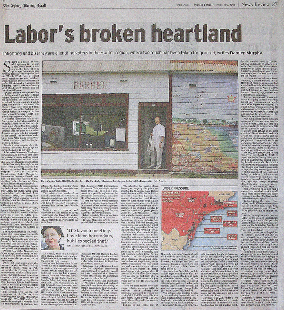
In a piece titled “Labor’s Broken Heartland”, the Sydney Morning Herald’s Damien Murphy writes:

“Infighting and disarray are alienating voters in the Hunter region, where too much has been taken for granted.”

“Preselections have been botched, chosen candidates have shot themselves in the foot, branch members have been ignored while pro-developers manoeuvre to oust those wanting to hold onto the past, and perhaps worst of all, the Right-dominated Labor headquarters in Sussex Street, Sydney, has meddled in Hunter business.”

“The powerbrokers seem to have forgotten that Hunter voters are capable of turning against Labor.”
Murphy quotes the policy-shy, Sydney-appointed, ($100,000 plus) Sydney-funded ALP candidate for Newcastle, Jodi McKay, as saying that “a lot of people believe in change” – a big statement for a Labor candidate in an electorate that has changed its electoral support for Labor only once in its entire history.

Another, similarly titled, piece (“Broken Heartland”), by seasoned local political observer Neil Jameson in this weekend’s Newcastle Herald, also examines Labor’s the apparent Hunter implosion, and suggests that Labor is “looking vulnerable in Swansea, Newcastle, Port Stephens and Maitland”.

Jamieson quotes Sydney’s McKay as saying “I challenge anyone who’s running to get out there and meet the people.”

Good on you, Jodi! I’ve been doing this for weeks now, and I’m also hearing from people that they might be ready for a change – from a right-wing Sydney-dominated ALP that seems to be in political free-fall.

My challenge to you (again!), and to anyone else who’s running, is to start telling voters what you stand for. The people of Newcastle deserve more than empty cliches and mantras, or doughnuts from head office.

You’ve said that you believe in coal, so what’s your solution to climate change? If elected, what will you do about the political donations from developers that are contributing to the reported $100,000 plus funding your Newcastle campaign? What are your policies on public transport, the future of the Newcastle heavy rail service, the Royal Hospital development, the Mater public/private partnership….

It’s now been 59 policy-free days.

The chocolate frog prize is still in my fridge.

Will we receive our first McKay policy as a present for Christmas?

Jesters in the court

Jesters in the court of Old King Coal

In a column titled “Green jihad a disastrous idea” in Friday's Australian, Dennis Shanahan - the well known right-wing Political Editor for the Australian, and a long-time, outspoken eulogist for the policies of John Howard and George Bush - attacked Newcastle Council’s decision to support a cap on coal exports from the Port of Newcastle. The Australian 10/11/06

Mr Shanahan’s (entirely predictable) views on this issue repeat the usual blinkered vision and scare tactics of the coal lobby. He bridles at the suggestion that society might “levy the coal industry to fund its own closure and find jobs for the displaced workers”, as though the principle of “polluter pays” is somehow a revolutionary notion, and that the mining corporations who have made such huge profits from our natural resources don’t have some obligation to help coal-dependent communities to restructure their local economies for a more sustainable future.

“Just Transition”, according to Shanahan, “is greenhouse-friendly code for sack workers.” [Those who are interested in what “Just Transition” really means can visit the Minerals Policy Institute’s website at: Just Transition.] Here is an excerpt from that site:

A Just Transition is how the Hunter can build a new economy from local skills and knowledge, with greater social equity. It protects the well-being of people and communities who are most vulnerable as we make a shift towards sustainability.

A Just Transition builds new partnerships from the bottom-up. It links communities, farmers, trade unions, businesses and governments to promote development that does not destroy. It shifts the debate from “Why change?” to “How can we change together?”

A Just Transition would guarantee:

* new secure, long-term jobs for people working in industries that are currently being threatened or displaced by the coal industry;
* new jobs in clean energy production, manufacturing, agriculture, services, tourism, arts and research to replace those being lost as the coal industry cuts its workforce;
* investment in education and training to develop the skills needed for a new economy;
* investment in infrastructure such as better health and public transport and expanded research and development so new, clean industries and skilled workers will be attracted to the Hunter;
* investment in repairing the environmental damage caused by large-scale coal mining and poor rehabilitation;
* investment in clean, decentralised energy technologies to replace the Hunter’s coal-fired power - a mix of energy efficiency, wind, solar, with gas playing only a limited transitional role.

Rejecting a Just Transition for the Hunter, Shanahan instead backs the views of Joel Fitzgibbon, Labor’s former federal Resources Spokesperson and Member for Hunter (which Mr Shanahan appears to confuse with the Federal electorate of Newcastle). Shanahan quotes Fitzgibbon’s portrayal of the Beyond Coal campaign as “extreme environmentalists” who “are launching a jihad against the industry in an attempt to close it down”.

The title of Mr Shanahan’s article clearly endorses this shallow attempt to associate local environmentalists with a term now negatively linked in many Australians’ minds with Islamic terrorism (though we would be quite happy to embrace the apparently more accurate translation of jihad as “a struggle or striving for good”).

Neither Mr Shanahan nor Mr Fitzgibbon point out that The Greens and other local environmentalists are backing a staged transition away from coal - rather than some kind sudden switch-off exactly because such a process would allow local communities to gradually restructure their local economies. Neither of them point out that jobs in Hunter mines have fallen from 10,000 in 1990 to about 6800 in 2003, according to New South Wales government figures, while production has doubled - see the facts here, or that an investment in renewable energy offers the possibility of many more jobs than coal.

Whilst Shanahan’s article is thin on substance, it’s a good example of the kind of treatment that the apologists for the climate changers will hurl at us in the coming campaign.

10 November 2006

Speaking to people face-to-face

Today, I was out once again door knocking, this time in the Merewether-The Junction area.

Many people mentioned that they thought this Sydney-Labor Government was arrogant and did not listen to the people of Newcastle.

Some said how it was dreadful that local people in the Labor party couldn't even choose their own candidate.

Many commented that this election was going to be very interesting.

Indeed.

09 November 2006

A world of interest

There's a tracker on the blog which records the location of the people who read the blog.

Since the landmark climate motion went up and the media was alerted, apart from Australia this site has had hits from:


Argentina
Belgium
Brunei Darussalam
Canada
Costa Rica
Egypt
Germany
Hong Kong
India
Italy
Malaysia
New Zealand
Poland
Portugal
Russian Federation
Saudi Arabia
Spain
Sri Lanka
Sweden
Switzerland
United Kingdon
United States


We live in a global world!

Recent climate change media

The following media has been obtained from the landmark climate stance of Newcastle City Council.

Radio
KO-FM
2HD
2NC
Television
NBN
Newspapers
The Newcastle Herald
Sydney Morning Herald
"The local voice is now loud and clear. The ball is now very much in the court of the state and federal governments to act."
The Australian
"COAL might be mother's milk to Newcastle, but as far as the port city's council is concerned, it's weaning time."
The Daily Telegraph
"The decision came at a significant time, with the NSW Government considering a major expansion of the Hunter coal industry and the public spotlight on the Federal Government's climate change policy."
Also in
The Age
The Herald Sun
The Courier Mail
Adelaide Advertiser
The West Australian
Sunday Times
Yahoo.com.au News
News.com.au News
ninemsn.com.au News

Response from blog reader

There has been much media in the last day or so on the historic motion passed by Newcastle City Council. This is from today’s editorial in the Newcastle Herald with a response from the first Greens councillor on Newcastle City Council, John Sutton.

Herald Editorial:

GrandstandingMost Newcastle ratepayers are unlikely to be impressed by their councillors’ grandstanding over the mining and export of coal. The issues are ones over which the council has no control and the calls for a cap on exports and a ban on new mines ignore the complexity of the issues involved, as well as the cost to the city and region of lost jobs. The councillors should get on with the task of looking after road repairs and other council responsibilities, as they were elected to do.
[Herald, Thursday, November 9, 2006]


Response:

Congratulations Michael!

In my experience, it’s a pretty good indicator that you’re on the right track with an issue when the Herald editorial writers attack what you’re doing – especially when they drag out the old “grandstanding” chestnut, which I’ve come to realise is Herald code for “Oh, oh, it looks like people might be starting to agree with [insert almost any progressive stance here], and we just can’t muster anything substantial to say against it”.

Remember, as the voice of Hunter development interests, these editorial writers have done it for years with the Newcastle rail line. And they did it with the Crowne Plaza longwall hotel (which even local developers have now admitted is a blight on the city landscape). In fact, it’s hard to think of an occasion in recent history (certainly since the days of Denis Butler) when a Herald editorial has come out against a controversial major development proposal in Newcastle.

Unfortunately, it’s the fate of Greens to point out inconvenient truths long before the anonymous antediluvians who write Herald editorials understand what is really going on.

I’m sure you won’t be taken in by the Herald’s view that the council (the only generally elected body that can claim to represent the city) should deal only with issues such as road repairs, and not bother about big picture matters such as coal and climate change.

Are they so stuck in the old “roads, rates and rubbish” rut that the penny hasn’t yet dropped with them that climate change affects everyone, and that it’s everyone’s responsibility – including all our spheres of government? Do they really think that the council of the largest coal exporting city in the world should say nothing about this city’s role in one of the key issues facing the planet?

Perhaps they just haven’t caught up yet with the changes to the Local Government Act (1993) that gave councils the responsibility to “exercise community leadership” [cl.8(1)], and to carry out “activities to properly manage, develop, protect and restore, enhance and conserve the environment in a manner that is consistent with and promotes the principles of ecologically sustainable development” [cl.403(2)]. Lobbying and advocacy to other spheres of government in the interests of the local Newcastle community is just one example of an activity where local government can dispense this responsibility, especially when the other spheres are as Neanderthal in their thinking about these matters as … well… Herald editorial writers.

Sure, Greens councillors must attend to local issues such as road repairs, but you don’t have to ditch the planet to do this. I’m sure that you know that the voters who put you and three other Greens on Newcastle council don’t want you to ignore the larger issues facing our city and our planet, as the Herald editorial suggests.

I can assure you that when I was a councillor I received many calls from Newcastle ratepayers encouraging me to raise big picture issues, and to get the council to advocate on behalf of the local community to other spheres of government to take action on a whole range of mattes such as indigenous issues, nuclear power, waste management, public transport, air pollution, smoking, animal welfare, water pollution, planning… I could go on. The point is that people recognise and value the general governance role of modern local councils because they understand that so many of the important issues cross spheres of government responsibility, and that ecological processes especially are so damned uncooperative in appreciating the boundaries that we draw on maps, and the fine distinctions that we make in our legal instruments.

The truth is that Newcastle Council would be derelict in its duties if it said and did nothing about this issue, particularly at a time when our city, our region, our country and the rest of the world are now struggling to come to grips with the climate change challenge.

I note that the Herald editorial doesn’t explain what its authors see as the “complexity of the issue”, but I think Greens understand these well enough. We know the social and economic restructuring that will be necessary for local communities as we phase out our dependence on coal; we’re aware of the challenges of shaping an alternative energy future involving reduced levels of consumption and a shift to renewable energy sources; we understand that this is going to involve some hard decisions during a difficult transition. What the Herald editorial writers clearly don’t understand is that decisive action is now necessary – Australia can no longer afford to fiddle while the planet burns. But we also understand – in a way that the Herald editorial writers clearly don’t – that if we do act now, it isn’t all doom and gloom. For example, the Herald editorial talks of “lost jobs” in capping coal exports, but doesn’t acknowledge that coal industry jobs are in historic decline, whilst there are plenty of jobs in moving to alternative energy, as long as we don’t miss the boat.

Of course, The Greens have been saying this now for a long time, and the failure of governments (supported by industry) to take earlier action has vastly exacerbated the scale of the problem we now face. Whatever the Herald editorial writers say, it’s clear to anyone who understands this issue that the writing is on the wall for coal, and Newcastle Council has done the city, the region and the country a favour in pointing this out, and offering some suggestions for a way forward. The time for a Just Transition has come.

Don’t expect the council resolution on the coal cap and the new mine moratorium to be the end of the matter. As I discovered a number of times when I was a Greens councillor, you can expect a strong reaction from vested interests and the governments and politicians they’ve bought with their political donations.

Remember the old Gandhi line: “first they ignore you, then they laugh at you, then they fight you, then you win”.

Rest assured, it won’t be the last time that you find yourself croaking, along with the famous frog, “it’s not easy being Green”.

John Sutton
Newcastle Greens councillor (1991 to 1998)


[PS: One thing that many people don’t realise is that newspaper editorials represent the views of only a very small number of senior journalists in a newspaper. Most of the journalists who work for newspapers such as the Herald play no role at all in the views expressed in the paper’s editorial, and frequently disagree with them. We certainly shouldn’t assume that this particular Herald editorial represents the views of all (or even most) Herald journalists on the council’s role in the coal/climate change debate. Notwithstanding its consistently anti-progressive editorial stance, I believe that the Herald still plays a crucial role as a local news source, and I have great respect for the integrity and professionalism of Herald journalists with whom I have dealt over the years.]


08 November 2006

Going through the motions

The community has much cynicism about the State Government's assessment of coal industry projects, with many feeling that the Government is merely "going through the motions".

The Planning Minister, Frank Sartor, appointed a "Panel of Experts" to investigate the Anvil Hill coal mine proposal in September 2006 and hearings were held from 17 to 19 October 2006. For more information see

Department of Planning website
Drawing a line in the sand
Court challenge
Govt trying to circumvent court
But written more than a year before, by another arm of the Government, the electricity generator Macquarie Generation, is a section in their State of Corporate Intent 2005/2006 pre-empting the approval of the Anvil Hill mine.

On page 6:
− In preparation for delivery of coal supplies from the low cost Wilpinjong mine and the Anvil Hill mine, the Corporation is in the process of developing a new rail coal unloader at Antiene on land owned by Macquarie Generation. This project will involve additional train sidings and unloading capacity totalling up to $75 million.
So it seems one arm of Government was "in the process of" spending $75 million, while another arm of Government was "going through the motions".

Environmental assessments Sydney-Labor style.

Landmark Council decision


Newcastle Greens
MEDIA RELEASE
8 November 2006


Newcastle turns up the heat on Climate Change

In a landmark decision, Newcastle Council last night supported a cap on coal exports through the Port of Newcastle at present levels.

“For the council of the city with the world’s largest coal exporting port to have the foresight and courage to say ‘stop, no more’ to coal exports is a truly historic and momentous occasion,” Greens councillor Michael Osborne (who moved the proposal) said.

“This decision should serve as a big wake up call to both State and Federal governments to get serious about climate change and to initiate a just transition toward sustainable energy,” Cr Osborne said.

Cr Osborne said he believed that Newcastle’s historic initiative might be taken up by other councils, and could have state, national and even international implications.

“I’m very pleased that most Newcastle councillors recognised the urgent need to protect local and global environments from increasing greenhouse gas emissions and to reduce Newcastle’s role in that increase.

“It’s especially significant at a time when the State Government is considering a major expansion of the Hunter coal industry, including massive new coal loading infrastructure and a new mine, and when the Federal Government is under increasing public pressure to catch up on climate change policy.

“Newcastle is in a unique position in this crucial issue.

“Nobody is closer to the coalface of this industry than the people of the Hunter, so the fact that the government of the region’s major city is prepared to support no expansion of coal exports through the port is a huge statement that should send a clear message to State and Federal governments about how serious Australians now are about facing up to the challenge of climate change,” Cr Osborne said.

As well as backing the cap on Newcastle’s coal exports at existing levels, the council also supported holding an inquiry into coal mining, a coal export levy, mandatory renewable energy targets, and improved public transport and cycling infrastructure.

Cr Osborne said that the much discussed Stern Report showed that each tonne of coal exported through Newcastle causes $264 of environmental and social damage – a fraction of the amount that we get for selling it.

“The local voice is now loud and clear. The ball is now very much in the court of the State and Federal governments to act,” Cr Osborne said.

The full text of the Council motion can be found on this site
and the background to the motion can be found and
on the Newcastle Council website.